



For years there has been a popular framing in venture capital about “investing at the edges.” The idea is simple. Pick a field, find the person pushing furthest into the unknown, and back them.
Fred Wilson (Union Square Ventures) described this idea as “we want to be investing at the edge of markets. We have found that attacking the status quo with a full frontal assault is difficult. Making an end run around it is a lot easier.”
I always liked the framing of investing at the edges. But something changed this year. The edges started touching each other.
Bio, robotics, defense, manufacturing, and aerospace have each advanced far enough that a founder can build in two or three of them at once, and AI is the reason it’s possible.
The tools underneath them, foundation models, simulation, and robotics, have become general enough that a chemist, a roboticist, and a defense operator can finally build one company together.
We’ve started calling them intersection companies.
A lot of what we’re backing this year looks like science fiction, and we explored a version of it in our Fund III announcement, “What If It All Works?”
Warhound (Bio x AI x Defense)
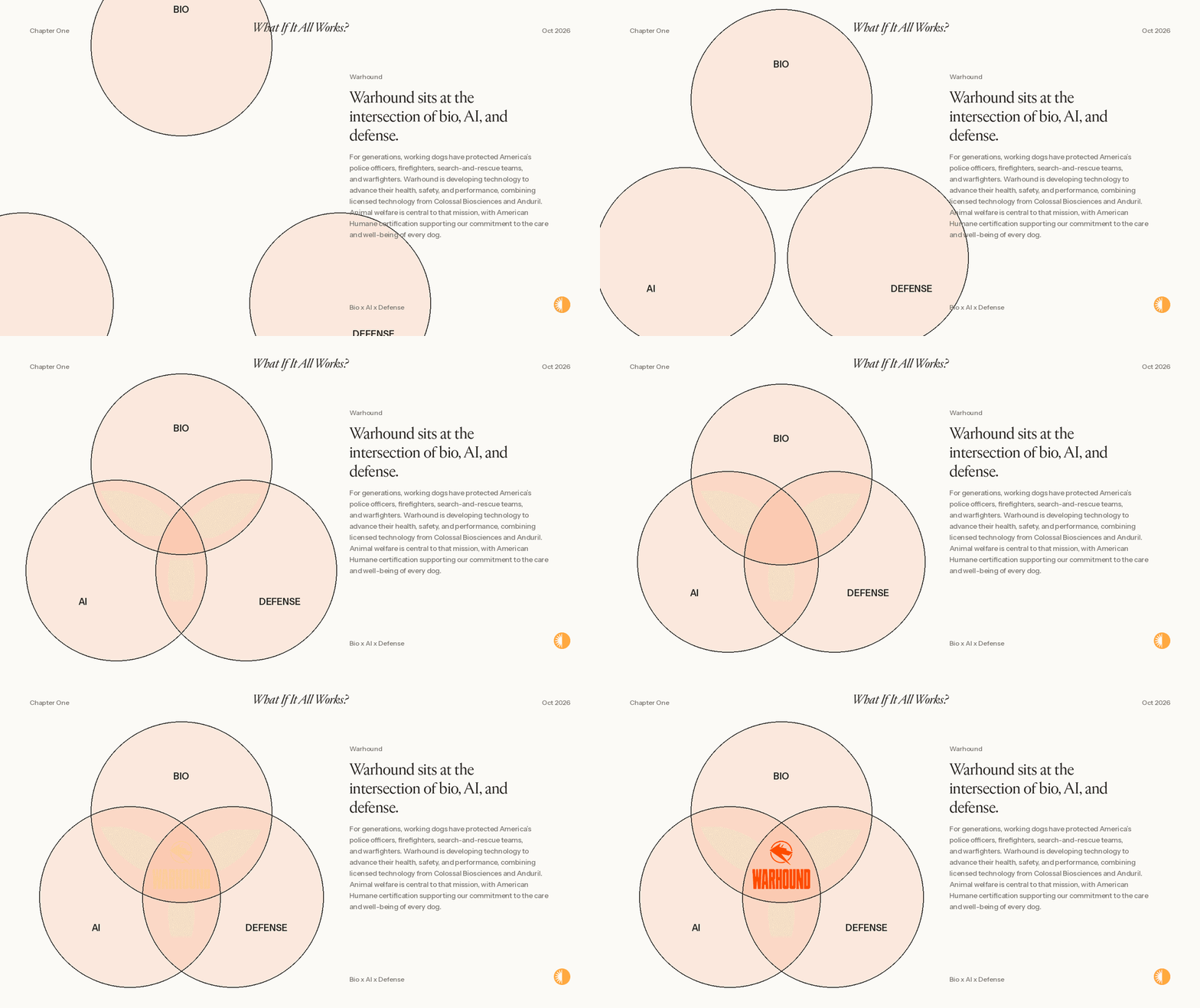
Chapter One invested in Warhound last week, and it is a perfect example. Warhound sits at the intersection of bio, AI, and defense.
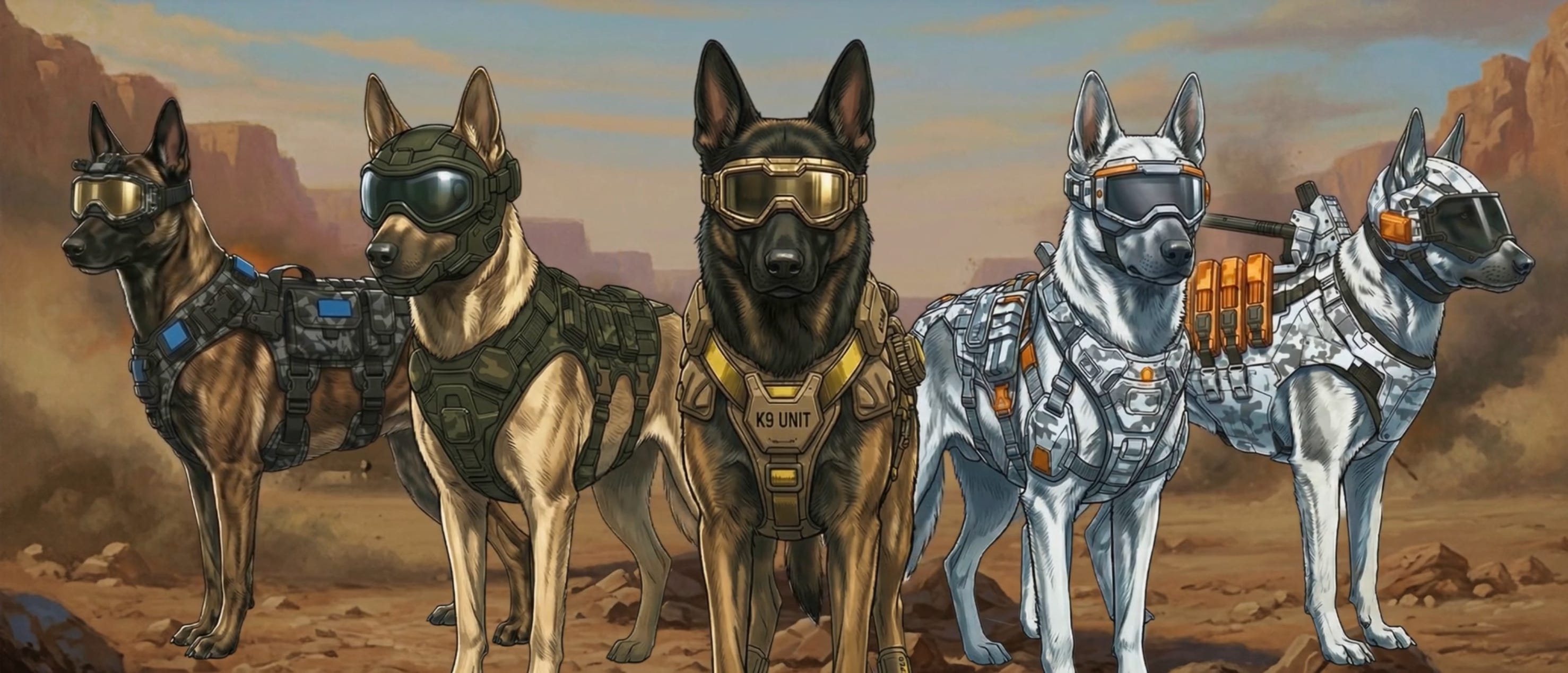
More than 80 percent of America’s military working dogs are bought from breeders in Europe, and fewer than half make it through training. Warhound licenses genetics technology from Colossal Biosciences to breed and clone dogs with the health, temperament, and physical traits the job demands, instead of hoping the right one shows up in a litter.
On top of the dogs it is building a data and software layer, using sensors and models to monitor health, track performance, and improve how dogs are selected and trained over time. And it outfits them with custom Anduril vests, goggles, and sensors, so the dog and the handler see the same picture as the rest of the unit.
The customers are the police, firefighters, search-and-rescue teams, and warfighters who have always depended on working dogs. They’ll have the first cloned ones next year.
Warp (Robotics x AI x Biology)
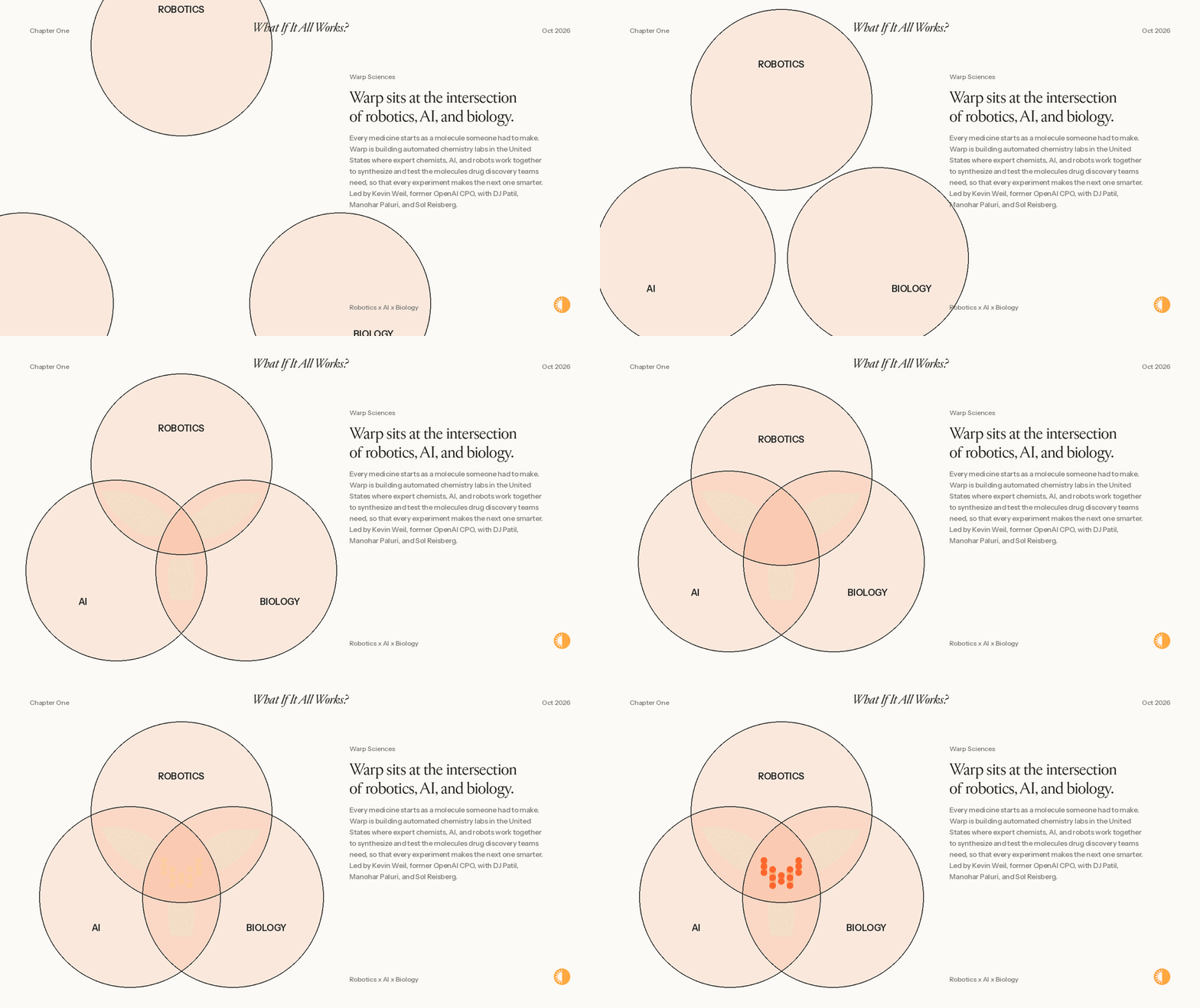
Another recent Chapter One investment that explains the intersections thesis is Warp Sciences, led by Kevin Weil, the former OpenAI CPO who went on to run OpenAI for Science.
Warp wants to build scientific superintelligence, an AI that can sit with a chemist, propose an experiment, and learn from what comes back. It’s starting with the molecules.
Drug companies send Warp a target and its chemists make and test the compounds, the unglamorous bench work most American biotechs have outsourced to China for twenty years. Warp is bringing it back to California and automating it, with chemists choosing what to test, software designing the experiments, and robots running them through the night.
Every experiment the lab runs makes the system a little smarter, and that is what the company is actually building.
Rock Band Teams
In earlier vintages, a software company was a CEO and a CTO who both came up through engineering. A hard tech company was a mechanical engineer paired with an aerospace or electrical engineer. Either way, two people who spoke the same language.
Intersection companies look nothing like that.
Warhound was built with Ben Lamm of Colossal, Palmer Luckey of Anduril, and Dave Spirk as CEO, who was Chief Data Officer for the Department of Defense and, before that, for Special Operations Command.

Warp was founded by Kevin Weil, who ran product at OpenAI, DJ Patil, the first Chief Data Scientist of the United States, Manohar Paluri, who co-founded Meta’s AI research lab, and Sol Reisberg, a medicinal chemist who spent his career making molecules at biotech companies.
Beyond the founders, Warp is hiring a synthetic chemist, two robotics engineers, and five software and AI engineers. These teams look more like rock bands than anything we’ve seen in prior vintages.
Combustion
Intersections also change where a company can go. One idea that we keep talking about with our limited partners is that the biggest companies of this era are going multi-product earlier and more aggressively than the last one.
When founders are building across three large fields, it’s impossible to predict the outcome as a seed investor. We underwrite with as much precision as we can, but at the early stages we are investing in the combustion of large markets with tailwinds.
The clearest case is SpaceX. It was underwritten as a rocket company for over a decade, and Starlink, a product that didn’t exist until the rockets got cheap enough to launch it, was $11.4 billion of SpaceX’s $18.7 billion in 2025 revenue, 61 percent of the company, when it filed to go public this year.
Another one showed up this week. How many of Anduril’s early investors underwrote a consumer electronics company? Anduril just announced BlueChip, which it calls an American computing product line, built in Ohio with chips from Qualcomm.
Here’s Palmer on why that wasn’t a stretch.
My drones are basically computers. They have memory, a GPU, a CPU, sensors, batteries, a rugged integration. The only difference between an Anduril attack drone and a laptop is a keyboard and a screen. That is not that hard to figure out, especially for a guy like me who started Oculus and comes from the consumer electronics space.
A company that already does hardware, software, and defense procurement at scale found that the next product was sitting at the intersection of all three.
Warhound’s first product is a better working dog. Warp’s is a faster way to make a molecule. The first product is the wedge, meant to make a bigger vision believable and bring in the talent and capital the company will need.
As early stage investors, we’re always underwriting a roadmap nobody has written yet. If a seed company fits neatly in a financial model, it probably isn’t thinking big enough. But when a company sits across three large markets, there’s always somewhere bigger to go next.
It takes some imagination at the seed stage, and that’s our job.
I talked about this with Morgan Barrett last week on his 30 Days of Hard Tech podcast. I’m going to try and do more video in the future. Hope you enjoy.