


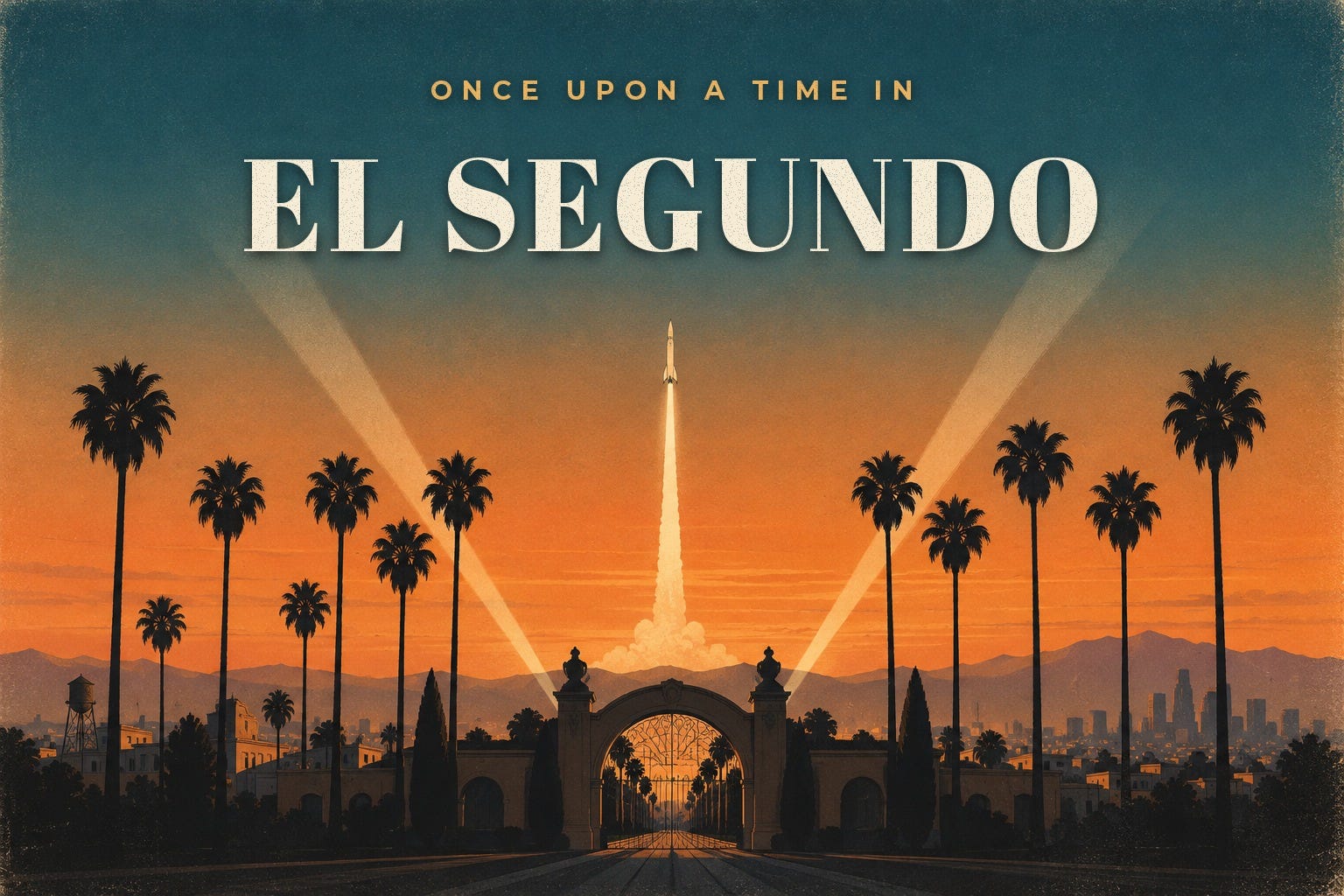
The most important thing being made in Los Angeles right now isn’t a movie.
In El Segundo, a small city wedged between LAX and a Chevron refinery, founders are building rockets, hypersonic missiles, nuclear reactors and more than a thousand drones a week.
But ask anyone outside the city what Los Angeles is known for and they’ll say Hollywood or Justin Bieber or something. And plenty of people who live here would say the same thing.
Los Angeles is the hard tech capital of the United States, and we need to start owning that.
Hollywood isn’t going anywhere, but it’s not the growth story it used to be. Over the past decade, a big share of production has moved to places like British Columbia, New Mexico, Louisiana and Georgia, lured by tax incentives.
Los Angeles has done this twice before. It went from farm town to movie town. Now, from El Segundo to Long Beach to Costa Mesa, it’s a hard tech town.

Chapter I: The Farm
In 1887, Southern California was in the middle of a real estate frenzy.
Land that sold for $500 an acre was suddenly listed at $5,000.
Promoters loaded trains with buyers from the East Coast and sold them lots in agriculture towns that only existed on paper. One of those towns was advertised as a “paradise of fruits, ambrosial shades and flowers.”
That same year, Harvey and Daeida Wilcox subdivided 160 acres of the Cahuenga Valley and named it Hollywood.
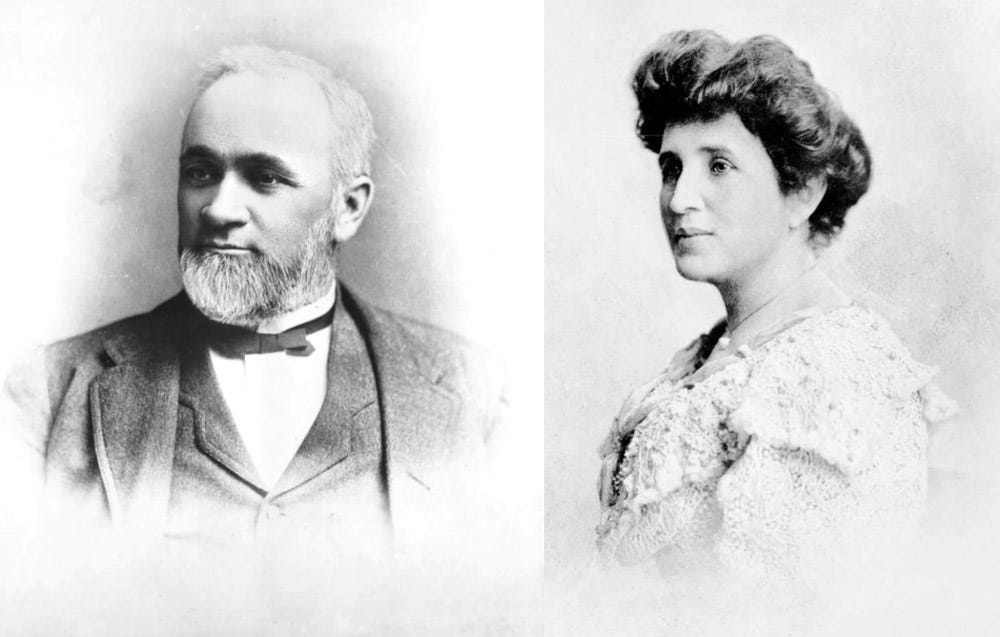
Harvey and Daeida Wilcox, the couple who named Hollywood. (USC Libraries/California Historical Society)
As the story goes, Daeida picked the name after meeting a woman on a train ride back to Ohio who had an estate in Illinois called Hollywood.
She and Harvey, a devout Prohibitionist, wanted their Los Angeles neighborhood to be a sober Christian town with no saloons and no gambling. Prospect Avenue, now Hollywood Boulevard, filled up with churches.
When the land boom collapsed in 1888, most of the new towns around Los Angeles went with it, but Hollywood managed to barely hang on.
Around the turn of the century, lemon trees outnumbered people, as farmers grew bananas, figs and winter vegetables in the frost-free foothills and shipped them to Denver and Boston.

Chapter II: Hollywood
In October 1911, two guys from Bayonne, New Jersey named David Horsley and Al Christie leased an old roadhouse at the corner of Sunset and Gower.
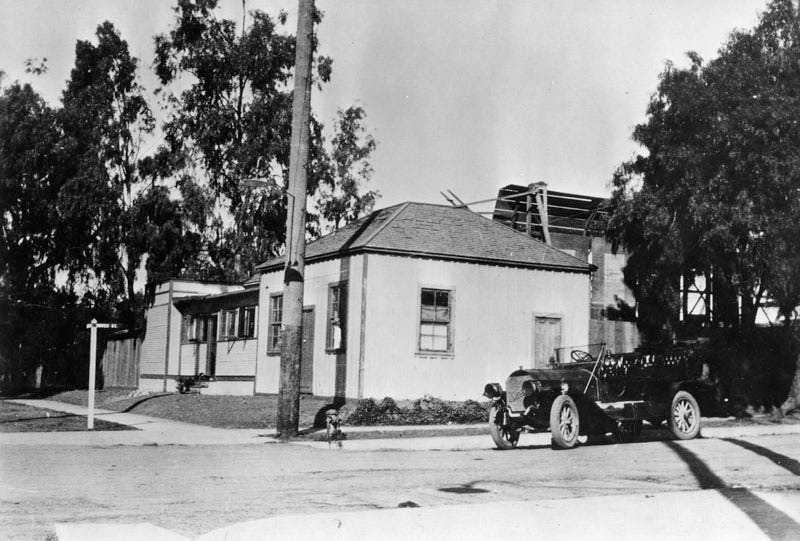
They turned the Blondeau Tavern into offices and dressing rooms. It became Nestor, the first permanent film studio in Hollywood.
In December 1913, Cecil B. DeMille showed up, and The Squaw Man became the first feature film shot in Hollywood. A few months later, Daeida Wilcox died. The woman who named Hollywood never saw the city become an entertainment town.
Within a decade, the lemon groves were soundstages. A religious town founded to keep entertainment away became the entertainment capital of the world.
Interlude: The Other Industry
Hollywood and hard tech have always kind of been neighbors.
In 1930, Howard Hughes released Hell’s Angels, a World War I flying epic. Two years later he founded Hughes Aircraft. The movie guy was a hardware guy, too.
But the real reason aerospace landed in Southern California is a wind tunnel in Pasadena. Kind of random I know, but here’s the story.
In 1926, the Guggenheim family funded an aeronautics lab at Caltech known as GALCIT. Caltech’s president, Robert Millikan, then spent four years recruiting Theodore von Kármán, probably the best aeronautical mind in the world, away from Germany.
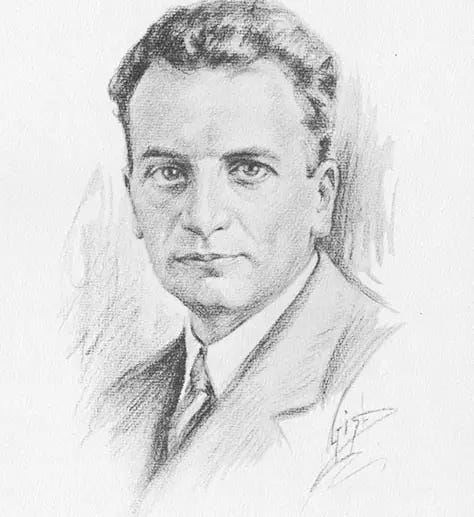
Theodore von Kármán, 1931. Wikimedia Commons.
In 1930, Kármán finally said yes partly because he could see hard times coming for the Jewish community in Germany. He took over a 10-foot wind tunnel he had helped design in Pasadena, the biggest and fastest on the West Coast.
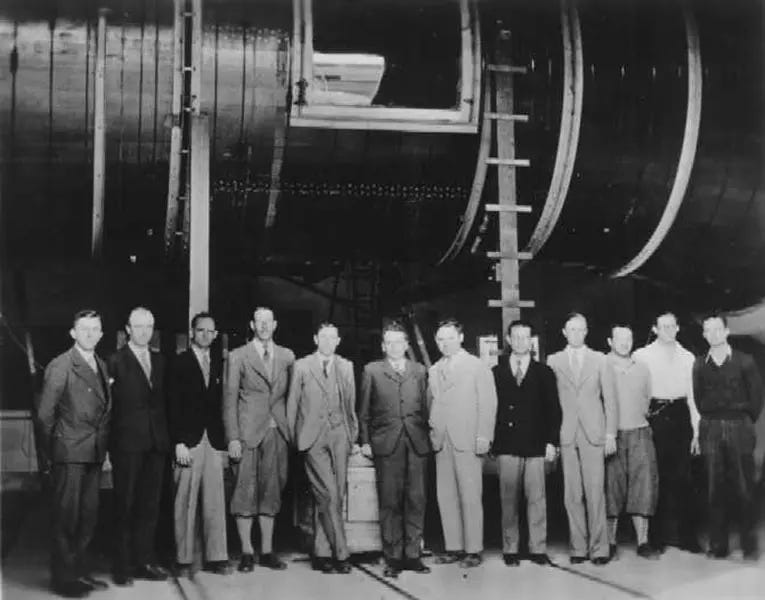
GALCIT staff in front of the 10-foot wind tunnel in Pasadena, 1930.
Northrop, Lockheed, Boeing, Douglas and Hughes all rented time in it to test planes like the DC-3, the P-38 and the B-29. If you wanted to build airplanes, you started near that tunnel.
In 1936, a group of students nicknamed the Suicide Squad started testing rocket motors in the Arroyo Seco with von Kármán’s blessing. Their work became the Jet Propulsion Laboratory.
World War II turned this emerging ecosystem into an industry. Douglas in Santa Monica and Long Beach, Lockheed in Burbank, North American in Inglewood, Northrop in Hawthorne and Hughes in Culver City. They built a huge share of the planes that won the war.
The Cold War kept the machine running and pushed it into space. TRW built satellites in Redondo Beach, Hughes built the first geosynchronous communications satellite, and The Aerospace Corporation set up next to the Air Force’s space program in El Segundo.
One of my favorite movies is Quentin Tarantino’s Once Upon a Time in Hollywood. It’s set in 1969 and follows Rick Dalton, a fading TV cowboy played by Leonardo DiCaprio, who realizes the town is changing and he might get left behind.
What the movie doesn’t show is what else Los Angeles was building that summer.
In July 1969, three Americans went to the moon and back on hardware built in Los Angeles. The Apollo capsule came from North American Aviation in Downey. The second stage of the Saturn V rocket came from the same company in Seal Beach.
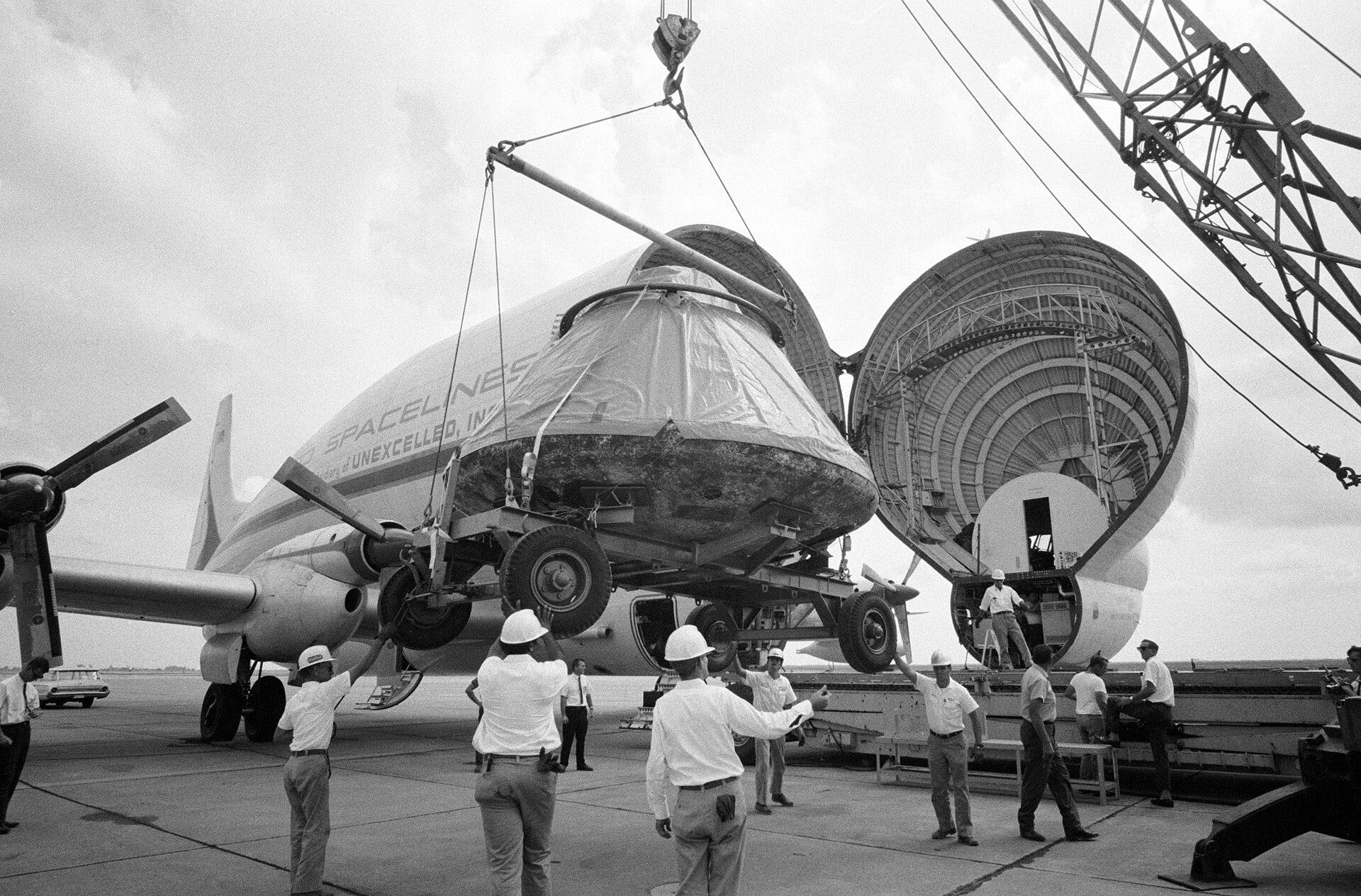
Columbia, the Apollo 11 command module, heading home to North American in Downey after the moon landing, 1969. (NASA)
By the 1980s, Southern California had about a third of the country’s aerospace engineers. Then the Cold War ended.
More than two dozen aerospace companies merged into three, and thousands of engineers and machinists who had built the most advanced machines on earth lost their jobs. For a while, it looked like the story was over.
It wasn’t. The primes consolidated, but they never left.
Northrop Grumman, Boeing, Lockheed Martin and RTX still run major operations here, from the B-21 bomber line in Palmdale to satellite factories in El Segundo and Redondo Beach.
Thousands of engineers and machinists stayed too, along with the small shops in Torrance, Gardena and Hawthorne that had built parts for the primes for decades. They were still here in 2002, when a 30-year-old internet millionaire with no rocket experience showed up in El Segundo looking for people who knew how to build one.

Chapter III: Hard Tech
Elon Musk started Space Exploration Technologies in a 3,000 square foot warehouse and office in El Segundo.
He had fewer than a dozen employees and no receptionist. He hired the engineers the old aerospace giants had left behind.
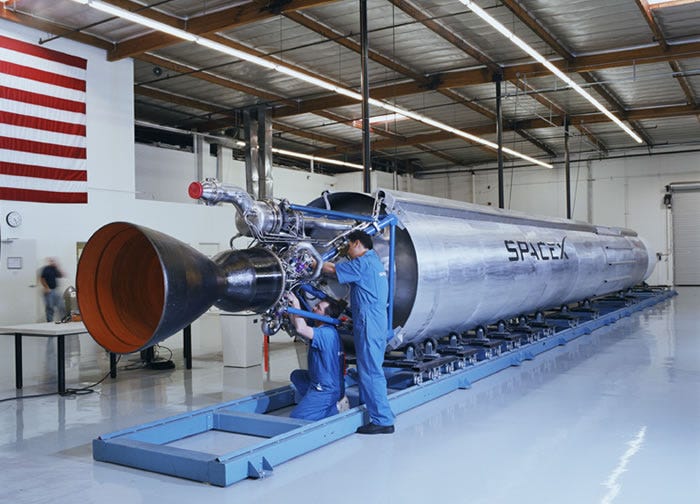
SpaceX’s early days. A Falcon 1 inside the El Segundo factory, around 2004. (SpaceX, CC BY-SA 3.0)
The first three Falcon 1 launches failed. After the third, SpaceX had enough money left for one more try. The team spent months picking through wreckage on their hands and knees to figure out what went wrong.
The fourth launch, in September 2008, reached orbit.
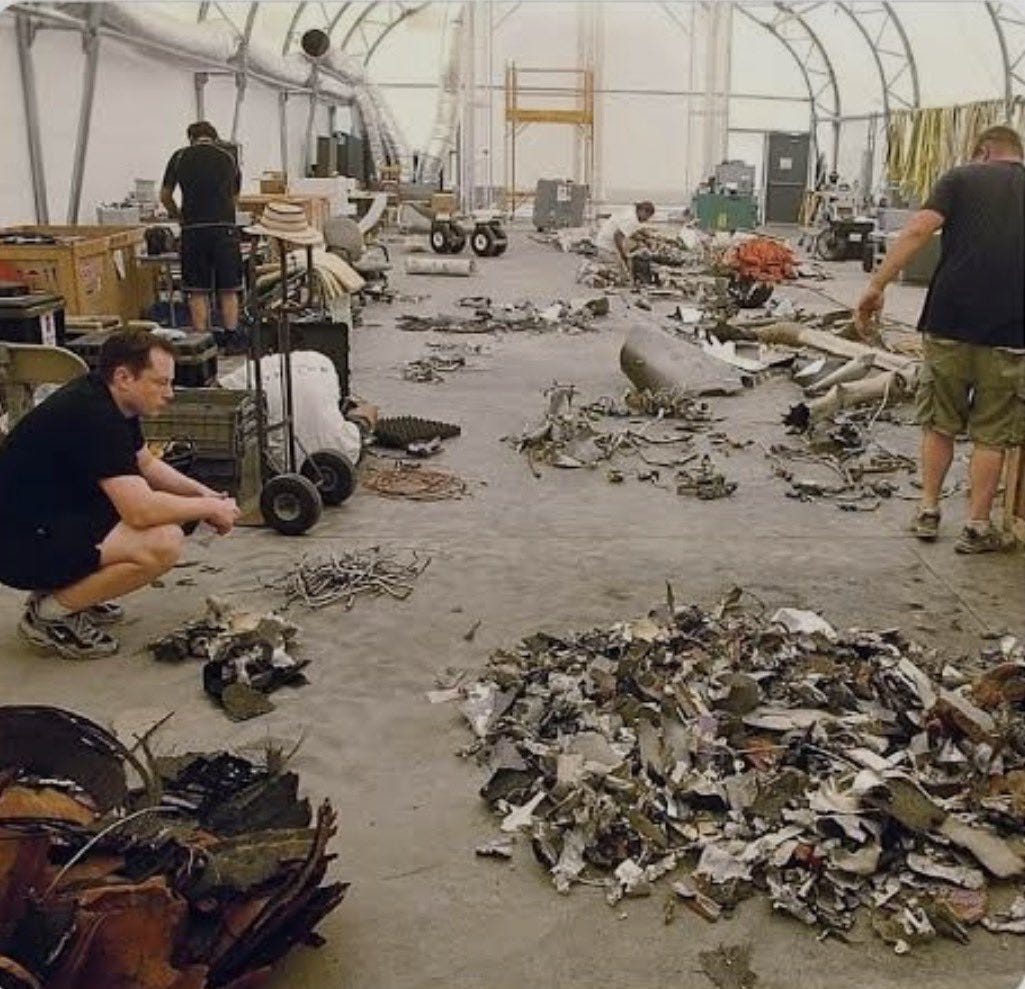
The SpaceX team sorting through wreckage after a failed Falcon 1 launch.
That stubbornness stuck, and it spread. SpaceX alumni have founded nearly 100 companies, many of them a few miles from that first office.
The Gundo
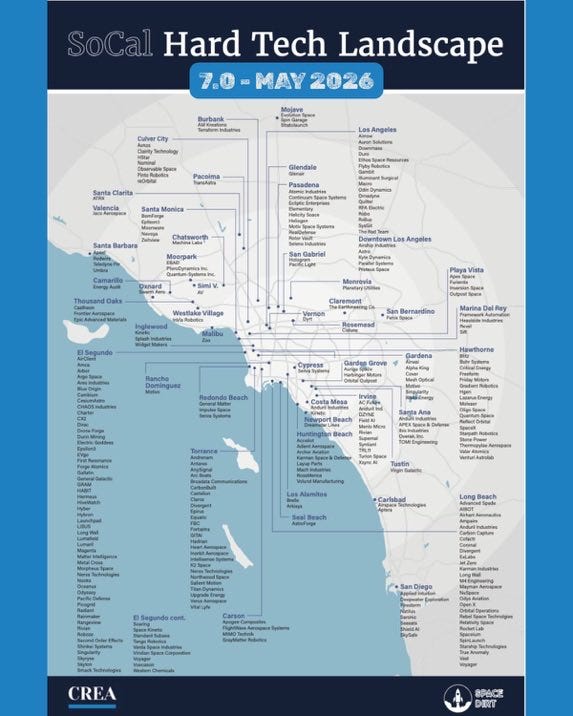
Space Dirt’s map of Southern California hard tech now has almost 300 companies on it, and El Segundo is the biggest cluster. (Space Dirt and CREA, May 2026)
Around 2023, a new wave of founders started showing up in El Segundo, and they found each other fast. Group chats turned into barbecues and Friday night bonfires.
People lived in each other’s houses, worked in each other’s factories and shared tools, vendors and freight forwarders.
Somewhere along the way, a local nickname became a brand. Gundo.
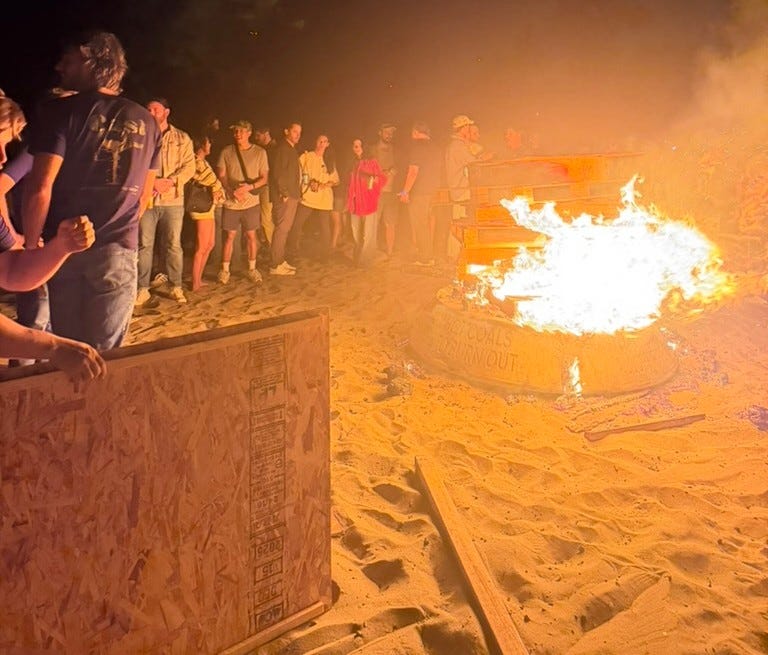
A bonfire at Dockweiler Beach, just down the sand from El Segundo. (Photo by Jeff Morris Jr.)
Made in LA
Neros started in 2023 in a 15,000-square-foot building in El Segundo. This year it won a $500 million Army contract and moved into a 250,000-square-foot factory in Torrance sized to build a million drones a year. It already makes about 1,200 a week.
Down the coast, Anduril in Costa Mesa has become one of the most important defense companies in the country. Next door in Huntington Beach, Mach Industries, founded by 22-year-old Ethan Thornton, went from a $5.7 million seed in 2023 to a $3.7 billion valuation this year. (Chapter One is an investor in Mach.)
Rainmaker is making it rain. Augustus Doricko’s team in El Segundo is using drones and radar to coax rain and snow out of clouds that would otherwise drift past. In a single winter, it made 140 million gallons of water across Oregon, Idaho and Utah.
Every rocket, satellite and drone in this story is built from thousands of precision metal parts, and most of those parts still come from small machine shops whose owners are getting close to retirement.
That’s the bottleneck Hadrian, in Torrance, is trying to break. It builds factories where software and robots do most of the work, so people who have never made a part before can be machining spaceflight hardware within a month.
Then there’s Valar Atomics. In June, a company that wasn’t yet three years old built its own nuclear reactor, fueled it and took it critical in the Utah desert. About a week later it used that reactor to make electricity and power an Nvidia chip live on camera.
Founder Isaiah Taylor’s grandmother was born in Oak Ridge, Tennessee, the Manhattan Project’s Secret City, and the reactor, Ward 250, is named after his great-grandfather, Ward Schaap, a physicist who worked on the Manhattan Project.
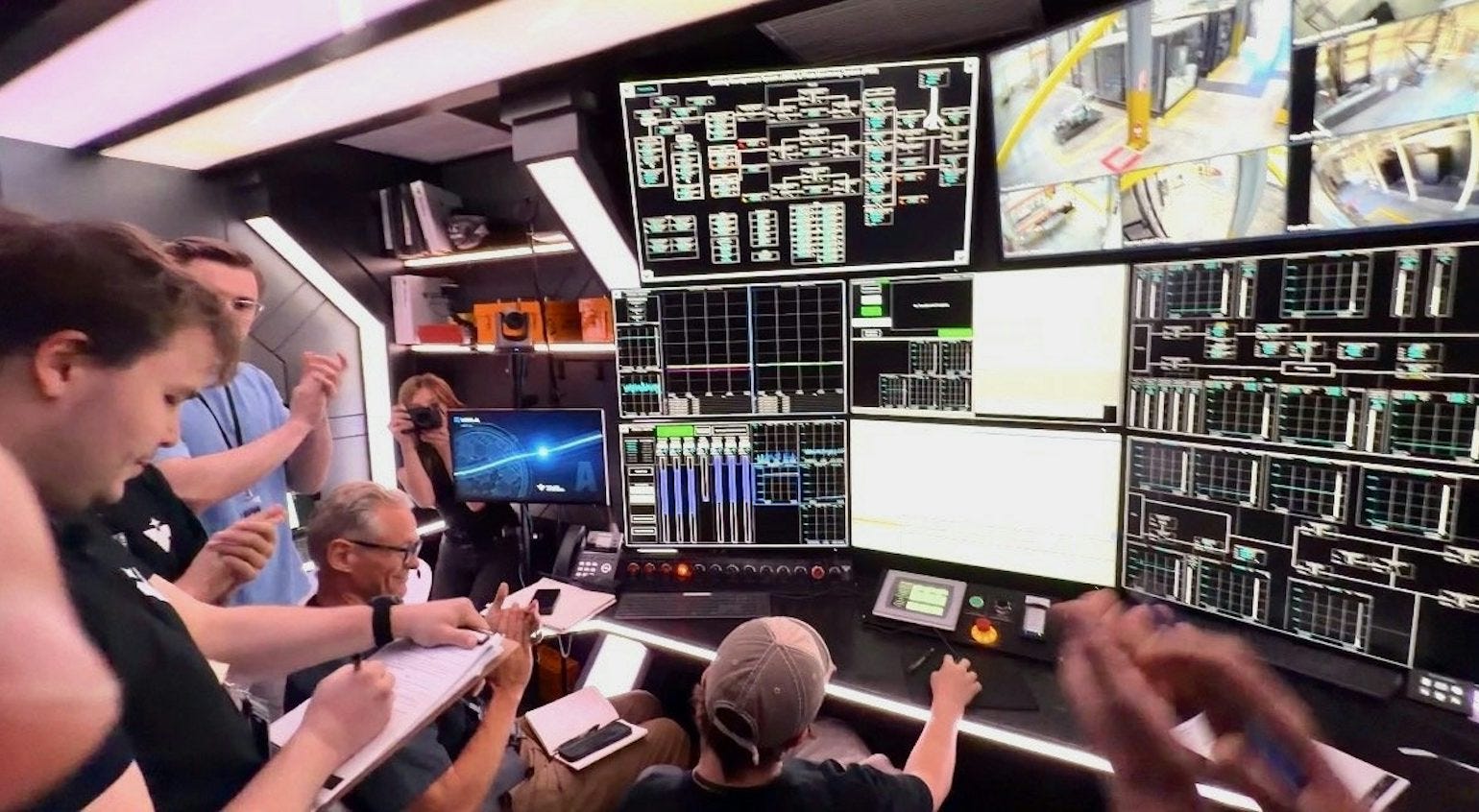
The Valar team in the control room as Ward 250 goes critical in Utah, June 2026. (Courtesy Valar Atomics)
The money has followed. LA-area defense tech companies raised more than $4 billion in 2025, double the year before.
In fiscal 2024, Los Angeles County received $315 million in direct DARPA funding, more than any county in the country, ahead of Fairfax County, Virginia, in the Pentagon’s own backyard.
Lookout Mountain
At Discipulus Ventures Demo Day in October, Sequoia’s Shaun Maguire walked a room of investors and operators, many from the Bay Area, through the history of Los Angeles hard tech.
The event was held at Lookout Mountain in Laurel Canyon. From 1947 to 1969, it was a secret Air Force film studio where Hollywood cameramen and editors made classified films of America’s atomic bomb tests.
Shaun’s argument was that Los Angeles became the hard tech capital because of three things. A century of aerospace talent and suppliers. A world swinging back from software to atoms, energy and defense.
And a cohort of crazy people, founders like Palmer Luckey, who came back to Southern California and made it the place ambitious young engineers wanted to be.
Many in the room had spent the last few years deep in AI, and Los Angeles hadn’t really been on their map. By the end of the night, you could feel that start to change.
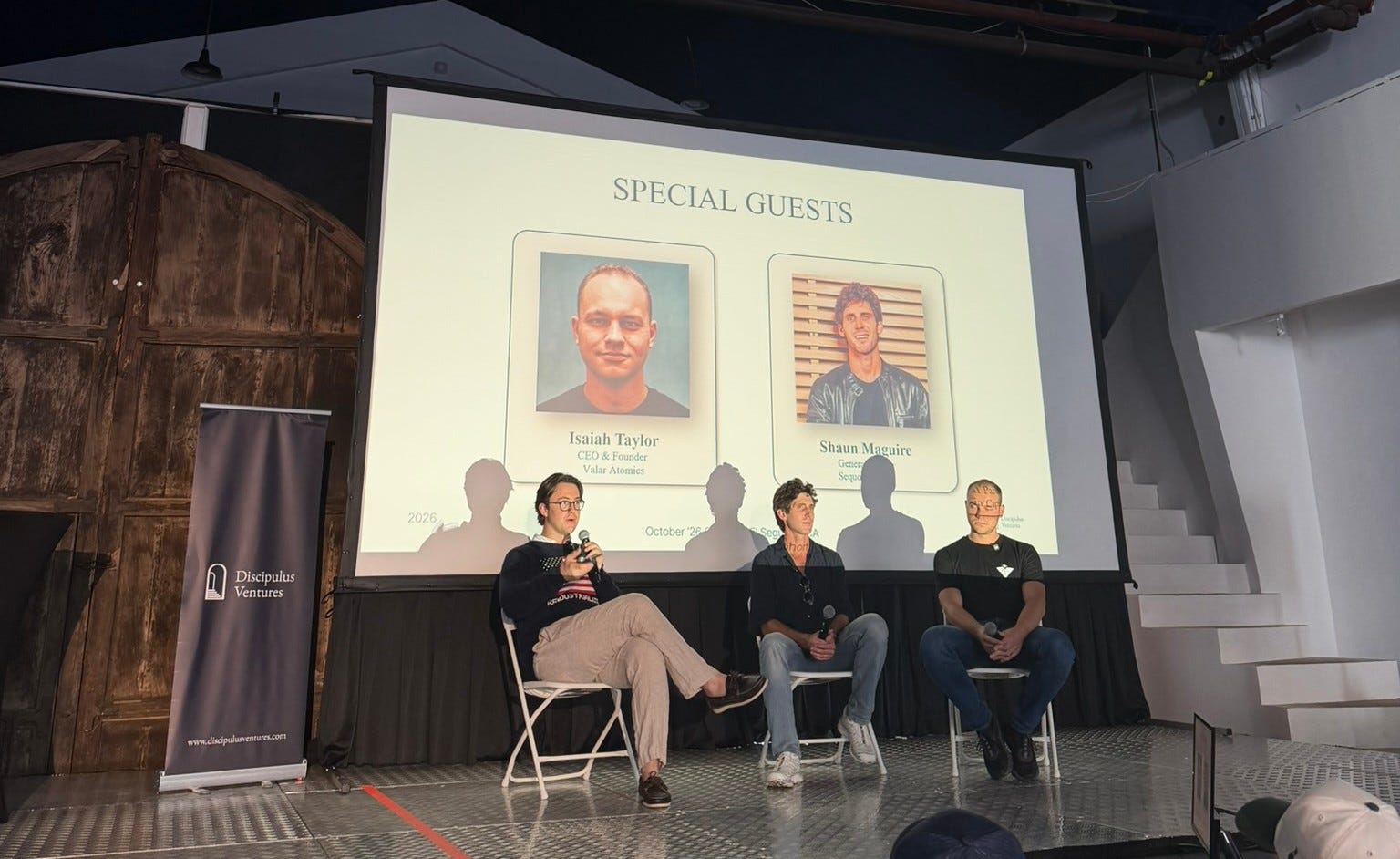
From left, Jakob Diepenbrock, Shaun Maguire and Isaiah Taylor at Discipulus Ventures Demo Day at Lookout Mountain Air Force Station in Laurel Canyon, October 7, 2026. (Photo by Jeff Morris Jr.)
As a Bay Area native living in Los Angeles, I’ve spent years caught between the two worlds. In venture, saying you’re based in LA can sound like you’re not trying to compete at the top.
When ChatGPT launched in November 2022 and the race to build foundation models took off, the narrative, in public and in private, was that every serious investor had to be in San Francisco.
I felt the pressure to move back north. A well-known San Francisco venture capitalist told me it would be “career suicide” if I stayed.
Instead, I started paying more attention to what was being built in my own backyard and I fell in love with the community I became part of.
Man, I’m glad I stayed. The Bay Area is building the models. Los Angeles is bringing them into the physical world.

Epilogue
Every chapter of this city started with someone everyone thought was a little crazy. Daeida Wilcox drawing a town on a map. Horsley and Christie renting a roadhouse. Von Kármán taking over a wind tunnel. Musk leasing a warehouse by the airport.
Los Angeles has always been good at getting people to believe in something before it exists. That used to mean movies.
Now it means drones, satellites and nuclear reactors.
When my kids grow up, I want them to know their hometown wasn’t about YouTube influencers and movies.
It built the planes that won the war, the spacecraft that reached the moon and the machines that keep our country safe.
Once upon a time, this was a farm town. Then it was Hollywood.
Now it’s the hard tech capital of the United States.